

Mastering inner peace is about cultivating mental calmness and emotional clarity amidst life’s constant movement. Inner peace is the foundation of authentic resilience and high performance. It is your inner peace and strong intrapersonal skills that are proactively securing your mental wellness.
Knowing how to keep inner peace is especially important for those leading teams, managing huge projects, and dealing with daily work pressures.
Understanding Inner Peace Opens Up Your Intrapersonal Abilities
Inner peace is your intrapersonal ability to remain calm and in harmony in daily life and amid different challenges.
It is the state of calm mind that allows you to act consciously, not reactively. What robs inner calmness is automatic subconscious inner reactivity.
Reactivity is the opposite end of calm-minded ability to respond (see the graph below). Such reactivity leads to worry, stress, anxiety, fears, etc. Those again cause, in the long run, burnout, anxiety disorders, depression, and other mental and physical health issues.

This website is about preventing mental health issues by nipping the problems in the bud. We see that training your mind allows calming your mind and sustains mental wellness.
A calm mind is more than a pleasant state; it is a trained mind capable of relaxing and making conscious choices.
A person with a calm mind understands how to lead awareness and sensing at will and has excellent interpersonal skills for self-leadership.
Inner peace comes from knowing your True Self (see the illustration below). Part of your being is consciousness, which in the passive form isn't very useful. However, when you learn to direct your awareness and sensing with awareness, awareness itself becomes an intrapersonal tool.
Awareness also enables you to notice, observe, and lead your thoughts, emotions, and imagination at will. The leader here is the silent True Self, empowered to use awareness and understanding and will.
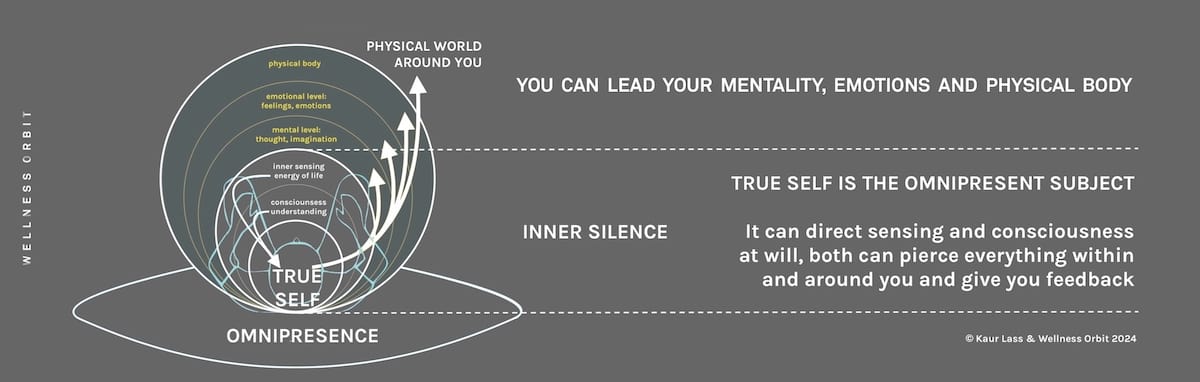
What you need to understand to secure your inner peace is that:
- Your True Self has zero tension.
- Your focus has zero tension.
- Your self-love is tension-free!
Interestingly, this doesn't mean you won’t experience any tension externally or internally. It simply means that You, as the True Self, don't possess tension.
When you choose focus, your focus needs to have a direction but remain relaxed and tension-free. When you experience self-awareness and self-love, that too is free of any strain.
However, your thoughts or imagination already have tension. Your emotions have even more tension than your thoughts. Negative emotions cause negative energy flow, and positive thoughts cause positive energy flow.
Emotional energy is always stronger than mental energy. That is why it is almost impossible to change negative emotions with positive thoughts.
Thoughts aren't very useful in leading your emotions; however, thoughts and emotions often align subconsciously.
What allows leading both thoughts and emotions is your awareness. Awareness is a neutral but most precise and efficient inner tool.
Most stress, anxiety, and burnout aren't caused by external events but by how your inner world reacts to different internal and external events. When your inner dialogue is chaotic and emotions are in turmoil, even minor issues can feel overwhelming. So, learning relaxation matters if you desire to remain calm and mentally fit.
When your mind is calm and your inner domain is in order, even major problems feel solvable.
Mastery Starts from Noticing Subconscious Reactive Patterns
Before you can master inner peace, you must first identify what disrupts it.
Many professionals fall into reactive habitual patterns: overthinking, emotional depletion, overworking, multitasking, or chasing constant validation. These patterns are often unconscious and formed from years of negative habits and failing to deal with inner pressure due to a lack of intrapersonal skills.
Reactive behaviors are partly taught to us, but mostly learned subconsciously; a fast inner reaction is an untrained and mostly inadequate response. It might look like checking emails late at night instead of resting, snapping during stressful meetings, or feeling guilty when taking a break to relax or being on a holiday. Often, your mind and body aren't aligned in such cases.
The illustration below shows a worried, anxious, and stressed person whose thoughts, imaginations, and emotions run wild versus a calm and present person. It is your inner calmness that gives you the option to be present and get things done.

Each of such inner reactive patterns quietly erodes inner peace. Recognizing them is the first act that makes transformation possible. You can't change what you don’t notice.
Take a moment each day to observe the current process within your mind. What irritates or triggers you?
What situations cause tension, defensiveness, or self-doubt for you right now?
Awareness is the beginning of freedom. Awareness of inner processes is the first step. Awareness of your awareness is step two, which allows you to lead yourself at will.
The Power of Letting Go
Peace begins when you stop fighting with what is.
Letting go doesn't mean giving up; it means accepting reality without any mental or emotional resistance. It means becoming realistic and fully present without inner fight or tension.
You aren't your thoughts, imaginations, or emotions. There is a cap between you and those inner processes. This cap itself is awareness.
In intrapersonal leadership terms, it’s shifting from subconscious automatic processing to conscious self-leadership and calm inner clarity.
You can’t control outer situations, but you can always control your internal state.
Letting go is also about releasing striving for perfectionism, unrealistic expectations, and the constant urge to prove yourself. Many professionals unknowingly attach their self-worth to productivity or recognition. That mental pattern creates endless pressure.
You aren't what you do. Your profession or achievements don't define you.
Your inner calmness and ability to love yourself and lead your inner processes matter more in the context of the inner domain than your professional title or role as a family member (be it mother, father, son, daughter, spouse, single person, etc.).
You, as True Self, in essence, are calm, serene, and mastery of internal and external processes is sourced from this knowing.
So, when you keep calm and consciously release attachment to any tension and outcomes and focus on the process at hand instead, you begin to operate from calm confidence, not fear of failure.
|


Cultivating Calm Through Daily Practice
Inner peace is secured through consistent, intentional practice. Start with small steps:
- Morning silence: Begin each day with 5 to 15 minutes of noticing the value of inner peace after sleep. Get out of bed, sit in a relaxed position, and use quiet reflection or slow breathing before touching your breakfast, phone, or emails. This sets the tone for a calm mind and calm action during the day. It teaches you to be fully present.
- Monotasking: Focus on one activity at a time. Multitasking scatters your attention and increases stress. Deep focus builds mental strength and presence. A calm mind knows its focus and thus also notices what needs to be done. It acts impeccably based on our professional skills and knowledge. Such a calm mind doesn't hurry; thus, it makes fewer mistakes and gets more done with less energy.
- Conscious pauses: Throughout the day, take shorter and longer breaks to calm your mind and refocus. Use such a pause after one task (or part of the task) is completed. Notice achievement and then relax and just close your eyes and feel where your feet are and how your breathing is. If needed, stretch and simply away from your work location, if you can go outside. Such conscious resets and pauses help your nervous system recover and your mind to calm. However, avoid social media or screen time for fun, as it keeps your mind busy. Boring, calm, and relaxed is here better than an interesting and engaging moment full of action.
- End-of-day reflection: Notice what went well during your day (at work). What was your lesson and what did you learn? Write down your tasks for the following day! This allows you to relax and step out of the need to remember while off work. Then pause and look at what kind of negative emotions you can release or let go of. This builds awareness and contains emotional tiredness.
- Silent nature walks: We used to live in nature and sense its rhythm and listen to its quietness. In modern offices, exposure to the busy city life and traffic flows, noise is almost constant. So, on the weekend or evening, find a quiet place where nature is calm. Leave your headphones in your pocket, car, or home, and just experience the outer silence, let it sink in. Find similar silence within and listen to silence. Become the silence you experience. Feel your true silent being. Relax into it.
Inner calmness is something everyone can master, as it is our natural inner state.
Leading your activities on mental, imaginative, emotional, and physical levels is trainable. Intrapersonal skills come in handy in doing so!
When you lead your mental and emotional processes at will, over time, your brain rewires toward peace rather than panic, focus rather than distraction.
The Connection Between Mastering Inner Peace and Success
In modern work, inner calmness is a strategic advantage. A calm mind listens with full awareness, notices details, and can freely choose a relevant conscious response.
A leader who can remain calm while dealing with uncertainty and challenges earns trust. A professional who responds with inner calm and uses an aware response makes better decisions.
A calm decision always beats reacting with mental complaints and emotional turmoil, which always removes presence and reduces trust. Teams guided by calm, clear-headed individuals operate with confidence rather than fear.
Inner peace sharpens cognitive function, opens up access to creativity and intuition, and strengthens the ability to lead your emotions.
When calm-minded people partner up, mental wellness becomes an organizational asset. A calm mind works, faces challenges, and leads better.
A Holistic Approach to Peace
Inner peace is holistic. Having a fit and calm mind allows to find joy of life in your mental, emotional and physical wellbeing.
You can't separate your work habits from your lifestyle or your self-talk from your outcomes. When your inner calm and mental wellbeing get neglected, the whole suffers.
Holistic mental wellness recognizes that harmony comes from integrating relaxation, mental and physical nourishment, caring relationships, and purpose into your professional life. It’s about aligning your inner values with your external actions. For this, you need to train your mind. The benefits of a fit and calm mind are seen on the right-hand side of the graph below.

When peace becomes your natural state, it supports your work and personal life.
Conclusion
Mastering inner peace is about meeting all challenges from a place of calm strength. It is your inner ability to stay calm regardless of the situation and act from clarity when pressure rises. Leading with calm compassion matters the most when situations are hard.
You can master your inner peace by knowing who you are. Your True Self is, in essence, always calm and reliable. It is the calm foundation of your inner domain. Your silent and powerful inner tools are your awareness and sensing.
When you know who you truly are and use awareness with awareness, your thoughts, imaginations, and emotions become your intrapersonal tools.
When you train your mind to stay calm and use awareness at will, you unlock a quiet power that no external circumstance can shake.
Inner peace is your most natural state; you just need to (re-)discover it. And in today’s fast-paced world, inner peace might just be the most valuable leadership foundation you can ever discover.
|