

Our fast-paced life tempo demands consciously taking moments of inner tranquility to restore harmony. Work demands, current economic situation, and focus on keeping your loved ones well often leave us overwhelmed, stressed or anxious. However, learning to relax is essential for our well-being, both mentally and physically.
This website explores different aspects of how to relax your mind.
Relax Your Mind
The first step toward actual relaxation in life is to relax your mind. Our minds are constantly buzzing with thoughts, imaginations, worries and memories, which can lead to mental fatigue.
To relax your mind, you need to remove stress, anxiounsess, and other inner tensions. Your natural state, as True Self, is relaxed. Knowing this matters. To act, you need awareness and a relaxed way of leading processes within and around you.
To lead processes in your mind, it’s important to possess practical awareness-based intrapersonal skills that allow you to lead your inner processes at will. For example, returning to inner silence, instead of constant chitchat in your mind at will, allows relaxation.
The term mind is vague, so you need to dig deeper and separate the different processes in it. Your thoughts aren't the same as your emotions. Those two levels have a different energetic power.
Your mental layer consists of imagination and thoughts. You should have the freedom to use them at will and not to use them when you rest. A relaxed mind is thoughtless and without imagination.
Wellbeing is the foundation of relaxation, health and wealth. Being well is the source code of feeling relaxed and focused if needed. Focus isn't tension. Natural focus is a relaxed direction. A fit mind keeps focus in a relaxed way, and this is what makes it sustainable.
A focused mind knows how to use all inner tools, your thoughts, emotions, and imagination at will and at the right time.
Your emotional layer can have positive emotions that uplift your energy and negative emotions that downgrade your wellness and energetic power to act. What we are unaware of is that you can also have an inner calm and remain relaxed in your core without actively using emotions.
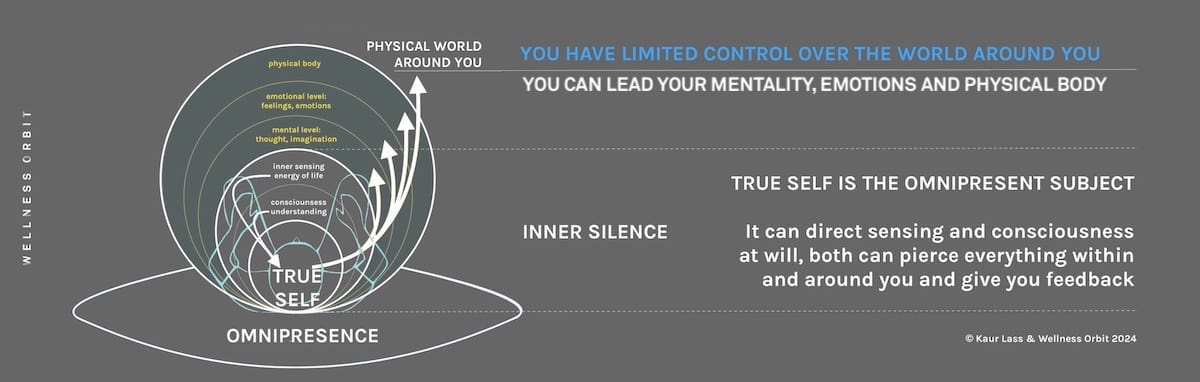
You aren't your imagination, thoughts, emotions, or even your physical body. You, as your True Self, should master those domains and lead them at will.
When you are your True Self, you find that you are calm, relaxed, and you feel the joy of life and love yourself and life; your energy will work in the external world most effectively.
How to become more relaxed?
One option is to relax your different inner layers one by one. But it is easier said than done for most people.
The easiest and most common option is to seek activities that promote mental calmness and relaxation. It is about the inner replacement of activities that cause tension, to activities that lead to a more relaxed state.
Meditation is one of the ways to achieve this. By looking where your feet are, coming in contact with the place you are, and focusing on your breath, you can calm your mind from racing distractions. Keeping your focus on breathing helps to quiet the mental chatter and become present in your physical body.
A most effective meditation isn't on any object; it is on your own relaxed being as the True Self. Your True Self has zero tension. Knowing this matters. Meditate on increasing your relaxation.
When you relax, your mind becomes calm. This is where you need awareness-based intrapersonal skills; those allow you to become a true leader of all your inner layers (see the graph above).
Let's observe why interpersonal skills matter in the following graph.

Intrapersonal skills provide the most efficient self-leadership option in your daily life and work situations. You become fully aware of what is going on within you, and by using your awareness actively, as well as by sensing what is going on, you can understand what to do or not to do.
Your thoughts, imagination, and emotions should be led under your conscious will and not run wild.
While mindfulness is the practice of being present and fully engaging with your surroundings, learning intrapersonal skills will provide you with active self-leadership tools. These efficient inner self-leadership skills allow you to use awareness actively.
Whether you’re walking in nature, eating a meal, or simply sitting quietly, practicing being fully present and letting go of any inner process at will can help you to calm your mind. This reduces worry, stress and anxiousness.
.jpg "Take a personal stress test and enjoy feedback!")
|
Subconscious inner reactivity vs conscious response
The key is always to focus on the present moment and give up inner reactivity. Reactivity is subconscious and keeps you on learned paths.
The problem with your subconscious inner paths is that those are often copied and not relevant to your actual situation in life. Subconscious action is automatic, based on repetition.
You need to apply the power of awareness and intrapersonal skills to step out of subconscious automatic reactions.
Opposite to this is a conscious choice (see the video below). This is about taking full responsibility for every process in your mind. When your mind is calm and relaxed, it allows your body to relax as well.
So what actions are needed to relax into being and living consciously?
Letting Go of Thoughts
One of the biggest obstacles to relaxation is our inability to let go of persistent thoughts. Whether it’s a work-related worry, a personal issue, or simply the stress of daily life, our thoughts can often become overwhelming.
Learning to let go of thoughts is crucial for achieving true relaxation. One way to do this is through the practice of cognitive diffusion, which involves distancing yourself from your thoughts and viewing them as separate from your identity. This technique helps in reducing the power that these thoughts have over your emotions and well-being.
As said earlier, You are not your thoughts or imagination. The problem is here with the speed. You forget that between sentences and imagination, there are pauses. You are focused on thinking of imagination, and as your use of awareness (as a tool) is weak, you hop over the quiet moments between inner activities.
What if you searched for inner pauses that open the door to inner silence instead of inner activity?
If this seems difficult, engage in activities that distract your mind from typical autopilot thoughts. Reading a book, actively listening to music, or engaging in a hobby can provide a healthy escape from autopilot mode.
Doing what you love allows you to become present. And only in the present moment can your mind relax. Letting go of usual thought patterns is a good start.
Letting go of thoughts at will is the mastery; allowing your mind to become silent equips you with clarity.
Letting Go of Negative Emotions
Negative emotions like anger, resentment, and fear can create significant stress and tension in our lives.
Learning to let go of these emotions is essential for relaxation. You can find a book that helps you to let go of your negative emotions in one of our blogs – reading this book, ‘Practical Consciousness: Freeing Yourself from Emotional Addiction to Live a More Joyful Life’ by Ingvar Villido, allows you to take your understanding of your inner domain to a whole new level.

Holding on to grudges and negative feelings only harms you and your body in the long run. You can also use the power to forgive. When you are thankful for what you learned and forgive, you free yourself from the burden of negative emotions and create space for inner peace and flow happiness.
While many things can be hard in life, for sure, there are things that you can be thankful for. Be it a full stomach, a weekend walk in nature, or a moment watching your kid play. Find what is good on purpose. For sure, everyone has something good in their life. If you drop negativity, you can spot it!
Letting go of negative emotions is easy once you learn it. You can also document your journey of becoming more aware of your inner processes through journaling. This way, you can spot your progress.
Writing down your thoughts and feelings also allows you to notice what you deal with. By expressing your emotions on paper, you can gain a better understanding of them and find ways to see what your lesson is. When you read your experience, you can notice that you are not the experience, but the one who observes your experiences.
Relaxing Inner Tensions
Inner tensions often manifest on different layers, be it physical discomfort (like headaches), stressed or anxious feelings or negative thought patterns.
To relax your inner tensions, it’s important to identify the source of your active tension and address it directly. Fear is on an emotional level, worry is on a mental level, and all aches are on a physical level.
Only when you notice the inner source of the problem and focus on removing it consciously can you make a difference.
That is why on this website, we focus on teaching practical intrapersonal skills. Skills that allow self-observation and corrections in your inner domain.
Being present and conscious is the key. Only by spotting what is going on within you can you obtain the power to change your inner processes. That is why we promote intrapersonal education.
Relax Your Body
To achieve relaxation, it is also important to relax your body. Physical tension can build up in the muscles, leading to discomfort and stress.
The first step is to become fully present in your body. Only when you have the inner power to use awareness and sense to observe every aspect of your physical level can you adjust what is needed.

Regular exercise, such as going on nature walks, doing physical yoga asanas, stretching, or going to the gym, helps in releasing physical tension. Exercise allows relaxation after doing it. Additionally, taking a warm bath or a cold shower, getting a massage, or simply lying down and practicing deep breathing can relax your body and make a difference in your mood.
Quality of food and sleep matter as well. Casual constant eating or troublesome sleeping is often due to mental, emotional, or physical tensions. However, you have control over your body. So, choose a healthy eating pattern and decide on a firm time to go to bed. Avoiding screens at least an hour before bedtime is a must for good sleep. Darkness in the room also makes it easier.
Inner calmness allows you to fall asleep fast. Training your body, taking nature walks, and quiet time, and not eating before going to bed, are physical-level activities that support inner calmness.
Only by giving your body the care and attention it needs, you create a foundation for overall well-being. However, remember that a fit mind is interested in keeping a fit body. A fit body alone isn't enough; otherwise, no athlete would have mental health issues.
Training your body and mind matters, as you are a holistic human being with a physical body.
So, when was the last time you trained your mind? When did you train your body? Once a week for training, both actively is a minimum that you need!
|


The right way to act
Hopefully, you understood that noticing and releasing physical tension is important; at the same time, for walking or any physical action, the body requires some muscle engagement, and for this, there is tension.
For using your physical body sustainably, it’s essential to find the minimum necessary, or so-called optimal tension.
The same applies to self-expression, as you need to come up with the words that describe what you need to say precisely. Also, using imagination or any emotion consciously demands some tension.
What you need to discover is the smallest possible effort for using your thoughts, imagination and emotions at will. The less you apply the tension, the more you conserve your energy. It is learning to use the optimal amount of energy to get things done that matter.
When you find how to be tension-free in your inner silence and act with the lowest tension needed, you can live a harmonious and healthy life.
Conclusion
Intrapersonal skills are a must if you want to lead a wellness-centric life. Relaxation is a result of good self-leadership skills. When your inner being is relaxed, work and family life become easier.
A calm mind leads to maintaining a harmonic and healthy life amid all challenges.
By learning to relax your mind, let go of thoughts and negative emotions, ease inner tensions, and relax your body, you can achieve inner peace and well-being that allows you to navigate life’s challenges with ease.
Remember, relaxation is not a one-time event, but a continuous practice that requires attention and care. So, take the time each day to relax, and you’ll find yourself feeling more refreshed, energized, and ready to face whatever comes your way.
Understanding the art of mental and physical relaxation will secure you good health and work results, as well as pave a path to healthy human relations.
.jpeg "Relaxing your mind gives you inner calmness and allows you to deal with challenges")